PROFESSIONAL MILITARY EDUCATION

Military superiority will vastly rely not only on new technologies but also on human capital, and especially on leaders’ capacity to deal with future challenges. Therefore, Professional Military Education (PME) must support the reality on the ground by competently following trends of the military profession. It is for PME to create the common intellectual platform for contemporary leadership and build-up the necessary character of future core leadership able and fit to take the lead in the most improbable circumstances.
STRATEGIC LEADERSHIP

Whereas militaries reflect the contemporary complexity of international relations and are profoundly affected by technological advances, PME becomes a valuable source of forward looking and innovative strategically thinking future military leaders needed to lead through the anticipated complexity of imminent crises. PME evolution should find a response to the ultimate question: “What kind of education can assure that leaders are as capable as possible to respond to a contingency of future most complex security challenges?”
Developing military and civilian intellectual leadership skills to successfully deal with emerging challenges, within alliances or coalitions, remains the primary purpose and responsibility of PME. Leaders who can outthink adversaries, reconcile context, manage uncertainty, and surprise, and embrace change, will be the agents of much needed decisive edge.[i] In order to support such leadership development, it takes determination and agility of PME leaders to remain highly responsive to new strategic environments, identify the leadership competencies required to confront them, and implement the change to PME accordingly.
The evolving technological advancement in military affairs is in need of strategic, creative and innovative thinking to analyze the problem and amount the action vs. training to perform specific tasks. Use of accelerated learning, extended reality (augmented reality, virtual reality, mixed reality), robotics and autonomous systems, machine learning, and other enabling technologies, techniques, and requirements, will drive what, why, and how we respond in contested environments and how we prepare for them through training and education. PME traditional military skills are rightly valued but cognitive skills, often called critical thinking, will be the most important attributes necessary to enhance intellectual agility supportive of effective strategic decisionmaking.
[i] For more details see Lamb J. C., Porro B. 2015, Next Steps for Transforming Education at National Defense University, JFQ 76, 1st Quarter 2015, accessed 14 February 2019,< https://apps.dtic.mil/dtic/tr/fulltext/u2/a618534.pdf>
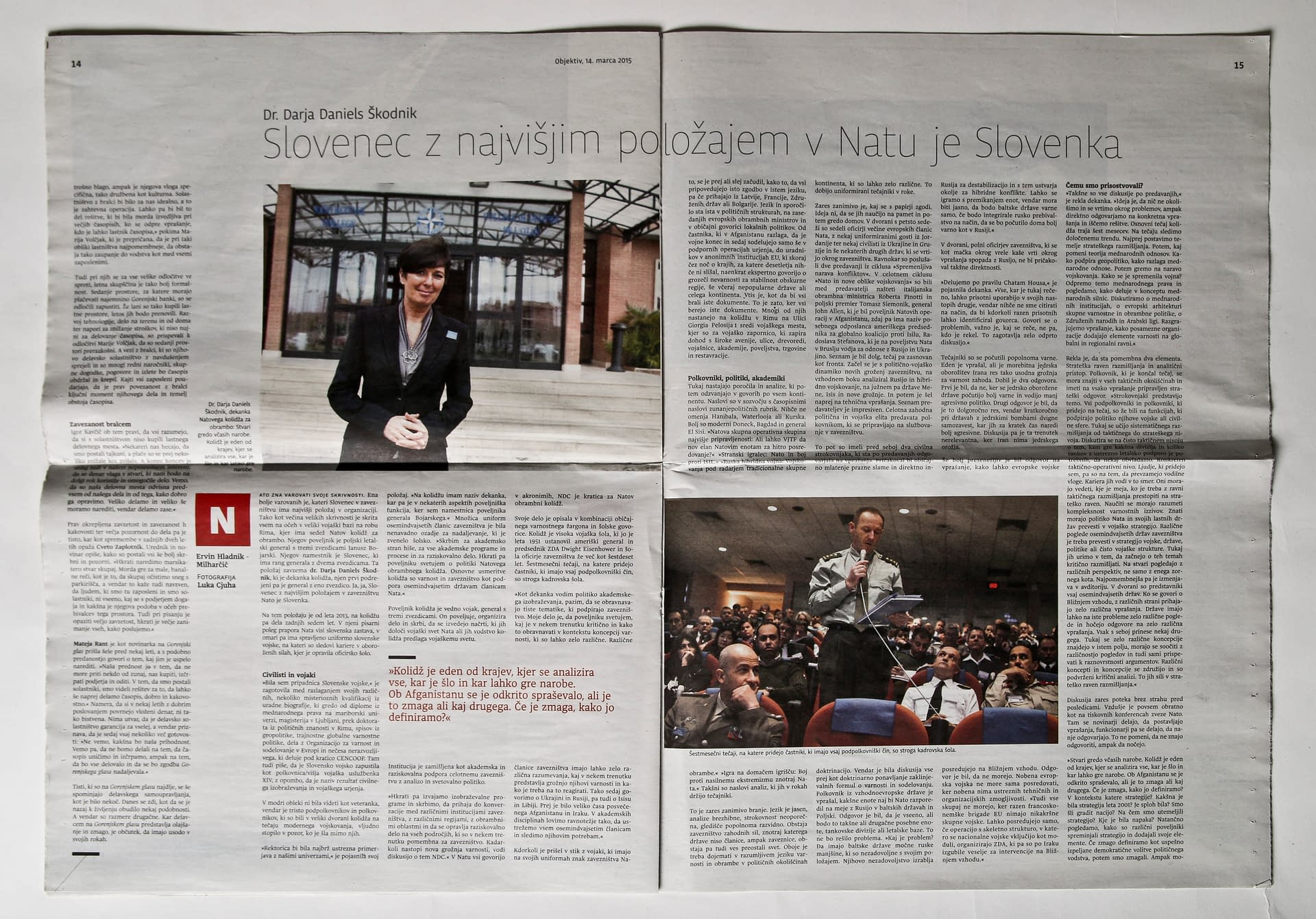
Interview entitled “Slovene with the Highest Position in NATO is a Women” by Ervin Hladnik – Mihalčič, Daily Newspaper „Dnevnik“, Rome, 2015